







Current Equity Exposure
We employ two distinctive dynamic market exposure models in our strategies: one tailored for growth-focused investors seeking aggressive opportunities and another designed for those with a more defensive approach, prioritizing capital preservation. *For illustrative purposes only.
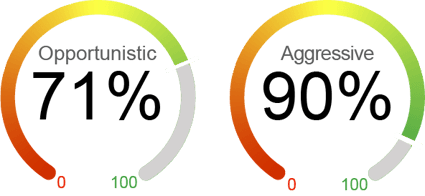
The US equity market experienced a weak month in November, with the S&P 500 and the Dow up modestly by 0.3% and 0.5%, respectively. The tech-heavy Nasdaq underperformed, losing 1.5%. Investors rotated away from over-crowded mega‑cap tech and AI leaders toward more defensive sectors such as healthcare. Worries over lofty valuations and uncertainty around the Fed’s rate‑cut timing contributed to the underperformance of the tech sector, though resilient earnings supported late‑month rebounds. Meanwhile, consumer sentiment remains low, evidenced by consumer confidence surveys from both the University of Michigan and the Conference Board. Looking ahead, we continue to see downward risks in the near term, including crowded risk asset positions, stretched valuations, and macroeconomic and trade policy uncertainties. On the other hand, the medium-term outlook could be bolstered if inflation and labor market data allow the Fed to proceed with further easing while earnings remain solid. With this backdrop, we are cautiously optimistic about the US equity market and have maintained the equity exposure of 71% in our defensive, tailored approach.
What's Driving the Markets?
Labor Market: The recent labor market data were mixed. The long-awaited September employment report looks stronger than expected, with job employment rising by 119,000. The gains were concentrated in a few sectors. Also, the downward revision to August resulted in negative growth for that month. The unemployment rate rose to 4.4% from 4.3%, largely due to a rise in labor force participation. The report's relevance is limited because it reflects the labor market situation from two months ago. Meanwhile, initial jobless claims have remained stable since September, indicating that layoffs are not yet a significant concern. However, continuing claims have increased to the highest level since late 2021, indicating that workers find it increasingly challenging to land new jobs, and weak hiring is the primary driver of slower job growth.
Low Consumer Sentiment: Both major US consumer confidence surveys - the University of Michigan Consumer Sentiment Index and the Conference Board Consumer Confidence Index - currently indicate a cautious household sentiment. The University of Michigan Consumer Sentiment Index remains historically low, declining to 51 in November from 53.6 in October. Meanwhile, the Conference Board Consumer Confidence Index plummeted to 88.7, the lowest level since April. Multiple factors drove consumer sentiment lower, including cost-of -living concerns, the prolonged government shutdown, and, more importantly, the weakening labor market and future income prospects. Although September’s job growth was unexpectedly strong, it was concentrated in several industries, such as healthcare. Also, labor demand is declining, and the number of WARN notices, which are filed by companies planning mass layoffs within 60 days, has increased significantly. Historically, when major consumer confidence indexes remain well below the long-term average, especially when future expectations indexes stay low, it might signal slower consumer spending and softer revenue growth in discretionary sectors.
Rotation Out of Mega-cap Tech and AI: After a long period in which a narrow group of AI‑focused mega‑caps led to market advances and extreme index concentration, parts of that trade started unwinding in November. Profit-taking trades were triggered by valuation worries, crowded positionings and whether AI will deliver sufficient profits to justify companies’ enormous spendings. Investors are concerned about significant physical limits to AI growth – especially huge, uncertain energy demands that the US may struggle to meet. The US and China's strategic competition over advanced AI is also a hot topic this month. Meanwhile, market leadership for November has rotated toward more defensive and less rate‑sensitive sectors such as healthcare and consumer staples, as investors rebalance toward stable earnings and more reasonable valuations .
By the Numbers
Valuation
|
Sentiment
|
Technical
|
Macroeconomic
|



.jpg)