







Current Equity Exposure
We employ two distinctive dynamic market exposure models in our strategies: one tailored for growth-focused investors seeking aggressive opportunities and another designed for those with a more defensive approach, prioritizing capital preservation. *For illustrative purposes only.
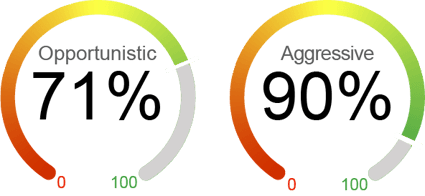
The US equity market was mixed in December, with the S&P 500 gaining 0.1%, the Dow advancing 0.9% toward its eighth straight monthly gain, while the Nasdaq dipped 0.5%. In 2025, all major US equity indexes delivered impressive performances as the S&P 500 climbed 18%, the Nasdaq was up 21%, and the Dow gained 15%, achieving three consecutive years of double-digit returns. In December, investors continued to rotate away from mega-cap growth stocks amid concerns over stretched valuations in tech and AI. Investors were generally encouraged by the Fed’s rate cut at its December meeting, but acknowledged the intensified dissent among committee members as a possible signal of a more gradual easing path than initially expected. Looking ahead, we continue to see downside risks, including stretched equity valuations, deteriorating consumer sentiment, a softening labor market, and macroeconomic and trade policy uncertainties. In 2025, tech sector stocks represented about 36% of S&P 500 earnings and 56% of capital investment growth, heightening market vulnerability to setbacks, including delayed enterprise AI adoption and energy constraints. Key tailwinds for 2026, on the other hand, include the Fed’s easing policy, fiscal stimulus, and still solid corporate earnings. With this backdrop, we are cautiously optimistic about the US equity market and have maintained the equity exposure of 71% in our defensive, tailored approach.
What's Driving the Markets?
Growth: According to preliminary data from the Bureau of Economic Analysis, US real GDP rose at an annualized rate of 4.3% in the third quarter, the strongest growth rate in two years, after increasing 3.8% in the second quarter. Consumer spending was the biggest contributor to growth, followed by net exports. However, we have to keep in mind that tariff policy changes have led businesses to import forward and consumers to shift spending, temporarily boosting growth in recent quarters. We believe that US economic growth still faces some headwinds, with the drags of higher tariffs and a weakening labor market. The recent strong pace of growth is unlikely to continue due to uncertainties, including slowing consumer spending, cautious business investment, mixed government policy, and inflation pressure. In addition, economists are concerned about the "K-shaped" pattern of consumer spending. Spending is increasingly driven by wealthy households, with the top 10% accounting for about half of the total spending, supported by rising asset values. Meanwhile, spending by the bottom 80% has merely matched inflation rates and resulted in cuts to discretionary spending amid increasing financial strain.
Fed Policy: As was widely anticipated, the Fed cut the federal funds rate by another 0.25% to the range of 3.50% to 3.75% during its December meeting. The committee has chosen a more accommodative policy stance, prioritizing a weakening labor market over inflation risks. Meanwhile, dissents increased from two to three in December, with one favoring a larger 50bps cut and two voting for no cut, reflecting deep disagreement over the pace of easing. The committee's economic projections showed minimal changes from September, with a modest increase in GDP growth forecast, an unchanged unemployment rate estimate, and a slight decline in the core PCE inflation forecast. Also, the Fed continues to anticipate one more 25-bps rate cut in 2026. Investors generally expect that Fed cuts will help to stabilize the labor market and support corporate earnings. Looking forward, we expect a potentially challenging year for the rate-setting FOMC, especially amid upcoming leadership transitions. The assumption that tariff-driven inflation will be temporary also remains to be tested. Our base case anticipates two possible rate cuts in 2026 and a gradual path of monetary easing through 2027.
Inflation: The November US Consumer Price Index (CPI) came in surprisingly cooler than expected, with headline CPI rising 2.7% year-over-year, down from 3.0% in September. The annual rate for Core CPI (excluding food and energy) also fell significantly from 3.0% to 2.6%. Shelter inflation declined to 3% year over year from 3.6% in September. The monthly change for CPI was unavailable due to the lack of October data resulting from the federal government shutdown. We warn that November's inflation data should be viewed with skepticism. The Bureau of Labor Statistics replaced missing October data with September prices for most CPI components, effectively resulting in zero monthly inflation for October and introducing a notable downward bias to November's year-over-year data. This kind of distortion should ease for the December CPI report, but shelter prices will still be potentially distorted for April and October 2026, as they use a six-month panel for calculation.
By the Numbers
Valuation
|
Sentiment
|
Technical
|
Macroeconomic
|



.png)