







Current Equity Exposure
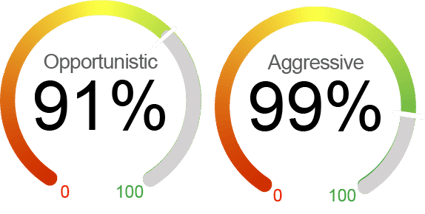
We employ two distinctive dynamic market exposure models in our strategies: one tailored for growth-focused investors seeking aggressive opportunities and another designed for those with a more defensive approach, prioritizing capital preservation. *For illustrative purposes only.
U.S. equities delivered a mixed and increasingly volatile performance in the first quarter of 2026, reflecting a transition from early-year resilience to heightened uncertainty by quarter-end. January began on a constructive note, with major indexes posting modest gains and broader market participation improving, as mid- and small-cap stocks outperformed large-cap peers. Economic data remained supportive, with a resilient labor market and steady growth reinforcing confidence in the underlying strength of the U.S. economy.
As the quarter progressed, market leadership began to shift. February saw increased volatility and a modest pullback in large-cap indexes, alongside a continued rotation away from concentrated mega-cap technology names toward cyclicals, mid-caps, and quality stocks. Investors weighed strong corporate earnings and improving economic indicators against persistent concerns around elevated valuations, trade policy uncertainty, and evolving expectations for Federal Reserve policy.
By March, macro and geopolitical risks became more pronounced. Escalating tensions in the Middle East – particularly the U.S.-Iran conflict – contributed to a sharp rise in oil prices, reigniting inflation concerns and pushing Treasury yields higher. This environment introduced renewed fears of a stagflationary backdrop, with markets adjusting to the possibility of “higher-for-longer” interest rates. Risk assets broadly declined during the month, and international markets – particularly energy-importing regions – faced additional pressure.
Despite these headwinds, the underlying economic backdrop remained relatively intact. Historical analysis suggests that while geopolitical shocks can drive short-term volatility, equity markets have typically demonstrated resilience and recovery over subsequent months. While risks persist – including geopolitical uncertainty, policy ambiguity, and valuation sensitivity – we continue to see selective opportunities supported by economic durability, earnings strength, and evolving market leadership beyond the largest technology names.
With this backdrop, we are cautiously optimistic about the US equity market and have slightly increased equity exposure to 91% in our defensive, tailored approach.
What's Driving the Markets?
Middle East Conflict: The US–Iran conflict has escalated during the month with attacks on energy infrastructure and the ongoing closure of the Strait of Hormuz, a checkpoint for about 20% of global oil flows. Crude prices soared above $100 per barrel, turning a regional war into a global energy supply shock. For global markets, the impact has been higher oil and gas prices, rising inflation pressures, and increased volatility across equities, fixed income, commodities, and currencies. International equity markets, especially the energy‑importing regions such as Europe and Asia, have suffered more. Uncertainty persists around how long the Middle East conflict will last. At this point, some investors seem to view the conflict as relatively short-lived. At the same time, investors also realized that reaching a ceasefire with Iran is far more complex than tariff negotiations, which the US can adjust unilaterally, given its economic dominance. The US-Iran conflict includes Iran’s geographic leverage over key Gulf oil routes.
Fed Policy: As widely anticipated, the Fed kept the federal funds rate unchanged at 3.50% to 3.75% at its March meeting, with one dissent who preferred another 25-bps cut. The Summary of Economic Projections showed a modest increase in its median PCE inflation forecast for this year, rising from 2.4% to 2.7%, along with a slightly higher forecast for real GDP growth. This indicates that policymakers view the economy as relatively resilient but inflation as more persistent. Despite a less favorable inflation outlook, the median policy rate path was left unchanged, still indicating a one-quarter-point cut in 2026 and another penciled in for 2027. The recent US-Iran conflict has led to soaring energy prices. However, policymakers view recent sources of inflation, including tariffs and a surge in energy prices due to geopolitical conflict, as supply-side shocks and short-lived. Therefore, the Fed has chosen to look through these temporary inflation pressures rather than react aggressively. There are concerns that if persistently elevated inflation leads to higher inflation expectations and becomes embedded in consumer and business decision-making processes, the Fed might have to tighten policy again. In our view, markets might be overpricing a hawkish policy response, and historically, such overpricing usually reverses once growth concerns dominate.
Higher Bond Yield: As the Middle East conflict continued, US Treasury yields rose, and returns were negative across various fixed-income asset classes. Rather than interpreting it as a purely risk-off environment, the market sees the recent conflict as inflationary and rate-supportive. The 10-year treasury yield surged from 3.94% at the end of February to 4.32% at the end of March. The ongoing conflict has created a broad energy and supply‑chain shock, sharply lifting oil prices and reigniting inflation pressures. At the same time, traders pushed out the timing and magnitude of expected Fed rate cuts, shifting toward a higher‑for‑longer policy path, leaving long‑term government bonds selling off and no longer acting as safe havens. Furthermore, rising oil prices tend to put upward pressure on the US dollar, increasing the prices of dollar-denominated assets for international buyers. In response, countries tend to sell these assets to support their currencies, which has contributed to a further increase in bond yields.
By the Numbers
Valuation
|
Sentiment
|
Technical
|
Macroeconomic
|


.png)

.png)