



.png)



Current Equity Exposure
We employ two distinctive dynamic market exposure models in our strategies: one tailored for growth-focused investors seeking aggressive opportunities and another designed for those with a more defensive approach, prioritizing capital preservation. *For illustrative purposes only.
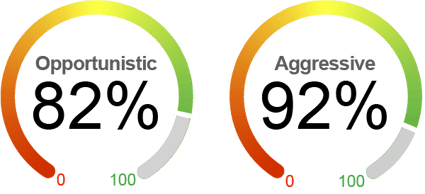
US equities were moderately lower in February, with the S&P 500 edging down 0.8%, the Dow generally flat, and the Nasdaq underperforming, down 3.3%. While large‑cap indexes were slightly down for the month, mid-caps outperformed, with the S&P Midcap 400 Index delivering a moderate return of 4.1% in February. Investors continued to rotate away from expensive mega‑cap AI names toward cyclicals, mid-caps, and quality stocks. Meanwhile, the US equity market has been volatile this month amid AI-driven pullbacks, tariff policy headline news, and escalating tensions between the US and Iran. The market has been keen to identify the winners and losers in AI development, as the semiconductor and hardware sectors have advanced while the software sector has experienced the steepest drawdowns. On the policy front, the Fed’s minutes highlighted divided views among policymakers about the future path of monetary policy. Our baseline forecast expects two Fed cuts starting around mid‑year. The Fed’s easing policy, strong fiscal stimulus, still-robust corporate earnings, and potential moderation of tariff-related drag set the stage for a backdrop that supports our relatively sanguine outlook for risk assets. We are also encouraged by the expanding PMI, stronger-than-expected January payrolls, and upbeat industrial production. At the same time, we continue to see downside risks, including stretched equity valuations, weakening consumer sentiment, geopolitical tension, and trade policy uncertainties. With this backdrop, we are cautiously optimistic about the US equity market and have increased equity exposure to 88% in our defensive, tailored approach.
What's Driving the Markets?
AI-disruptions: In early February, US tech stocks experienced a sharp valuation reset as investors revisited AI-related risks regarding software models and large-scale AI capital spending. A key ongoing theme is rotation away from tech into value, cyclical and more defensive sectors such as consumer staples, industrials and materials. The market has been identifying the winners and losers in AI development. Semiconductors and hardware sectors have advanced while the software sector has experienced the steepest drawdowns, with some software stocks down 30–50% from their peaks late last year. Emerging AI agents are increasingly capable of taking on software-related tasks, leading to the weakening of the competitive advantages of the sector. Investors are also concerned about the significant AI capital expenditure that may not deliver proportional returns, raising doubts about the profitability and margin sustainability of major tech companies. In addition, the sell-off has been further intensified by crowded positioning in AI winners and stretched valuations.
Growth and inflation: US real GDP grew 1.4% in the fourth quarter, after an upbeat 4.4% in the third quarter. The government shutdown was a primary drag on slow-than-expected growth, with the Bureau of Economic Analysis estimating it shaved at least 1% off overall economic growth. While year-over-year GDP growth is slightly higher than potential growth, the economic recovery remains fragile, as reflected in a softening labor market. The January nonfarm payroll increased by 130,000, exceeding consensus estimates. However, job growth was revised lower in all but one month in 2025, with the total net job gain down to only 181,000 from 584,000 for the year. In the meantime, recent inflation data has been mixed. The Consumer Price Index (CPI) came in as expected, with headline CPI rising 2.4% year-over-year, down from 2.7% in December. The annual rate for Core CPI (excluding food and energy) also fell slightly from 2.6% to 2.5%. However, the Fed’s preferred inflation gauge - the core personal consumption expenditure deflator - jumped 0.4% in December, lifting the annual rate from 2.8% to 3%, the highest level since 2024. The PPI was also stronger than expected in January (0.5%), as wholesalers passed through higher tariffs by raising prices. Recent inflation data, together with a relatively strong January employment situation report, reinforce the view among some FOMC members that the monetary easing cycle should be paused before mid-year.
Corporate Earnings: Corporate earnings remained one of the primary drivers of February equity market performance, as investors favored companies that exceeded expectations and offered confident 2026 guidance. A resilient economy, expanding manufacturing activities, and the Fed's easing policy have supported earnings and profit margins. As of 02/27/2026, 96% of S&P 500 companies have reported Q4 2025 earnings, among which 73% of the companies have reported a positive EPS surprise, and 73% of them have reported a positive revenue surprise. The year-over-year earnings growth rate for the S&P 500 is 14.2%, beating the projections by about 7%. Five of the eleven sectors are delivering double-digit EPS growth, including industrials, materials, financials, technology, and communication services.
By the Numbers
Valuation
|
Sentiment
|
Technical
|
Macroeconomic
|