






Current Equity Exposure
We employ two distinctive dynamic market exposure models in our strategies: one tailored for growth-focused investors seeking aggressive opportunities and another designed for those with a more defensive approach, prioritizing capital preservation. *For illustrative purposes only.
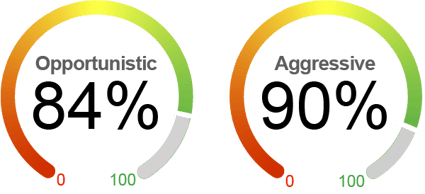
Major US stock indexes rebounded in April and finished the month higher, with the S&P 500 gaining 10.5%, the Dow advancing 7.2%, and the technology-heavy Nasdaq outperforming by rallying 15.3%. Despite ongoing uncertainty surrounding the Middle East conflict and higher-than-expected inflation, investors were encouraged by generally positive economic data, strength in technology and AI-related stocks, and solid corporate earnings. On the policy side, the Fed held the rate unchanged this month, with the most divided decision since 1992, indicating rising concerns about inflationary pressures. Disruptions in energy supply due to the Iran conflict, along with higher prices for chemicals and other industrial materials, are adding to inflationary pressures and shifting the outlook for Fed policy, putting pressure on equity valuations. Looking forward, while near-term geopolitical uncertainty persists, we believe that a prolonged confrontation is unlikely. In the meantime, underlying economic resilience, strong earnings momentum, and positioning are supportive for the equity market. With this month’s market rally, we took the opportunity to selectively rebalance positions while remaining cautiously optimistic on US equities, maintaining our equity exposure at 84% in our defensive, tailored approach.
What's Driving the Markets?
Middle East Conflict: In April, the Iran conflict entered an unresolved stalemate from an earlier outright conflict. Although a temporary ceasefire slowed large-scale attacks, the key economic development was ongoing disruption in the Strait of Hormuz, a critical channel for global oil supply. The economic impact became much clearer recently, as oil prices surged and the consumer price index jumped 0.9% in March, lifting the annual rate from 3.3% from 2.4% in February. Oil prices have eased later in the month as the strait reopened and diplomatic progress improved sentiment. The equity market also rebounded from March lows, reflecting investors’ expectations that escalation will remain contained. At the same time, reactions to the volatility of oil prices have been more muted, as investors are positioned cautiously, with lighter exposure and stronger hedging. While the recent ceasefire has provided short-term relief to energy markets, the situation in the Middle East remains unsettled, leaving room for ongoing uncertainty and potential risks of renewed escalation. Energy-importing nations continue to be the most exposed, but the US is not insulated, as elevated global energy prices can increase domestic fuel and transportation costs.
Corporate Earnings: The Q1 earnings season is still in its early stages, and the initial results are generally positive. As of 04/04/2026, 28% of S&P 500 companies have reported Q1 2026 earnings, with 84% of the companies reporting positive EPS surprises, and 81% of them exceeding revenue expectations. For Q1 2026, the blended (year-over-year) earnings growth rate for the S&P 500 is 15.1%. Also, most companies are maintaining or raising guidance despite recent geopolitical and macro uncertainty. However, AI companies such as OpenAI have missed their sales target, leading to a slump in shares of partners such as Oracle amid revived concerns over the sustainability of the AI spending boom. On the Middle East conflict, companies overall reported heightened concerns but limited immediate business impact. The energy sector is benefiting, while some sectors, including airlines and transportation, are under pressure.
Fed Policy: As widely expected, the April FOMC meeting kept interest rates unchanged at the 3.50% - 3.75% range. However, the meeting stood out for its unusually sharp divisions, with some members favoring a rate cut, while others objected to the easing bias in the meeting statement. The market viewed the Fed’s tone as slightly more hawkish as the statement emphasized that inflation remains “elevated” and mentioned that energy prices and geopolitical tensions contributed to the uncertainty. At the press conference, Chair Powell made an unexpected announcement that he intends to remain a Fed governor, and thus a voting member of FOMC, even after his term as Chair ends in mid-May 2026. Investors’ attention is also on the confirmation of Kevin Warsh as the new Fed Chair. We expect incremental volatility around Warsh’s early speeches and any shift in tone at the next FOMC meetings, rather than abrupt policy shifts.
By the Numbers
Valuation
|
Sentiment
|
Technical
|
Macroeconomic
|